Thursday, October 19, 2006

I Was Made For Smelling You

The Countdown Music revival seems to have worked, with 50 year old fans working the moshpit in their wheelchairs during the recent run of concerts.

So there's no reason why Gene Simmons (lizard tongued, blood spitting bass player from Kiss) shouldn't be mildly confident with his new range of fragrances - Kiss Him and Kiss Her.

"If people decide that a Kiss fragrance line makes sense," Simmons said, "who's to argue with America?"
Fair enough.

I wonder if this was his secret weapon for capturing women's hearts - 4,600+ notched on the bedpost apparently.


Gene Simmons points to the spot where Kiss Him should be placed for maximum effect

Wednesday, October 18, 2006

Managing Your Private Parts


Apologies for the long post ahead. I wish I knew how to only display the first part of it.


It's just not as much fun as it used to be for marketers in FMCG companies.

First Coles and Woolworths got so big and powerful that the execution and success of brand plans had just as much to do with a buyer's KPI's than it's relevance to the end consumer.

And now that Coles and Woolworths have started their drive to increase private label share of category, the implications for FMCG brands are massive. And if that’s the case, then the ad agencies of those companies will be impacted as well.


Graham, the new Brand Manager, misread the brief and charged off to produce the new 'You'll Love Coles' product with dire consequences.

The key trends are evident:

* Shelf space for brands is becoming tighter as PL brands grow share of shelf

* Brand line extensions often mean one in, one out from that brands current range.

* Each category is getting more polluted with brand line extensions. Ski Yoghurt bars how compete with Kellogs K-Time bars in 'nutritional' snacks.

* New innovations being introduced generally cost more and whittle away at total brand margin.

* The trade is giving new lines little time to make an impact, with the threat of deletion raised at the first sign of slow unit sales.


So what does this mean?

It means the single biggest opportunity for marketers is to take control of the future of their company's profits. Outmarket the competition. Be a smarter marketer. Now that's exciting!

It means that we as marketers need to make brands as relevant and appealing as possible.

It means we need to leverage the power of the brand.

It means we need to unlock the insights and understand how our consumers are going to respond to our brand proposition better than anyone else in the market.

It means that we need to ensure our brand is always part of the consumers repertoire in the category.

It means the comms strategy needs to engage the consumer, tell a story about the brand and register an emotional bond. A Brand Power ad may sell some product, but when the dust has settled, what's left in the consumer's mind?

It means the brand growth needs to come from more than just line extensions. Rather, tactical activity and line extensions need to contribute strongly towards the brand values and positioning which will make consumers like it and want to keep buying it.

And it also means marketing has a strong role to play in how Private label is managed within their business. Marketers have to balance a mix of managing products, brands, categories, innovation and their own private label offerings within those categories.

This being the case, what does this mean for marketers?

_________________________________________________

Marketing must control Private Label, not the Sales Function
The problem in a lot of companies, especially those traditionally driven by volume, is that the Sales team have too much influence on Private Label. In some companies they even own the process. A very dangerous structure.

The Sales team have been smacked around the head for so long by the trade that when Coles or Woolies ask for a private label, the Sales team generally shout yes and do anything to make it happen. I've seen instances where they've said yes without anyone in the business knowing, and as a result the company is more or less committed when everyone else finds out.

If Sales own the Private Label function, or have too strong a say in it, the marketer risks getting ambushed.

If it's an issue, Marketing must wrest ownership back from Sales and set strong groundrules about the in-house process.

Employ a dedicated private label marketer (that's a Marketer, not a Salesperson who's been given a chance in marketing) who works closely with the marketing team and sales team.

And performance measurements that revolve just as much around delaying PL launches (see below) and managing the 'no' argument back to the trade should also be part of it.

_________________________________________________

Know when to release innovation into the PL arena
Innovation is the lifeblood of growth for FMCG. And innovation is not getting any easier either. Marketing teams are working harder to bring profitable and unique new products or line extensions into the market, working on time frames from 6 months to 2 years from concept to launch.

Coles and Woolworths will want all successful new innovations as soon as possible for their own brands. When should you give it to them? The answer is to delay as long as possible. If it's something you own, say a proprietary manufacturing process, you could argue to never give it to the trade.

This obviously increases the risk that you might lose the business. Don't worry, at the next dutch auction you can win it back with a lower price. Because that's often all it takes to win the business. The trade are about as loyal as Hugh Hefner. Aldi excepted. They're more like Brad Pitt. Highly committed but you still know he'll move on at some point.

And if your business is absolutely reliant on a private label win to stay afloat, maybe the grass is greener in a more brand driven organisation.


Hugh Hefner has a rather large brand repertoire whenever he shops in the Blonde Bombshell category
_________________________________________________

Ensuring Private Label Growth Won’t Cut Your Brand Marketing Budget
Many MD’s see a Private Label win as an incremental profit boost. It helps fill the factories, the manufacturing team are happy, and the Sales team achieve their volume target bonuses. The Private Label balloon gets big.

Then what happens is that private label gets built into the company P&L’s. That’s the P&L for both PL and branded business. Some nice growth shows up and makes shareholders all happy. And the company needs to keep showing its shareholders that it will continue to grow versus the prior year.

The problem here is that private label business can be lost as easily as it can be won. All the balloon needs is a little prick and it’s gone. A competitor undercutting price by a few cents can be all it takes. And Hugh Hefner as a buyer.

Or some purchasing guy ordering the wrong caps resulting in a 6 week out of stock. Bang. Business switched.

Or the system goes down during the online Dutch auction that the vendors use to decide who wins the business (at the lowest price of course).

So when there’s a huge gap in the profit number to make up, where’s the first place the MD will look? Most likely at the Marketing budget. That’s the marketing budget of the brand, by the way – not the Private Label.


So what should a company ideally do?

1. Clearly separate Private Label from brand P&L’s. This sounds common sense but I've seen instances otherwise.

2. Redirect all incremental profit back into brand building activity. If not all of it, then 50% of it. Fight for this as a condition of the pitch process.

In this day and age of massive retailer power, manufacturers have their own weapon – the power of their brands. Because without a strong brand, the future’s not looking too bright.

These are a couple of initial thoughts and I'd be interested to hear any others on this particular issue.

Tuesday, October 17, 2006

Would You Like a Pest With That?

Parents have voted and McDonalds has been kicked in the McNuggets again.

"For the second year running, McDonald's has won the Pester Power Award in the Parents Jury Children's Television Food Advertising Awards. More than 1400 parents voted in the awards, which highlight the role played by marketing and advertising in the childhood obesity epidemic." quotes the Sydney Morning Herald.

This drummed up a bit of media in the papers over a few days, as well as a news report that night. What happens next? Like all news stories, it becomes tomorrows fish and chip wrappers. Well it would if they still wrapped fish and chips in newspapers. And you can't even find a decent fish and chip shop in Sydney these days to begin with, but that's another story.

One bloke reckons Macca's isn't even that bad for you, and lots of bloggers agree. OK, so they're white collar, tech savvy yuppies who are just bored at work, but that's nit-picking really.

I did a project for one company where they took a pro-active stance and did not advertise or run promotions directly targeted to kids. The competitor hasn't changed it's tactics. What's happened? Every competitor brand is showing growth and every brand from the company I worked for is in decline. Seriously. There's more to it than that, but it's a decision which has certainly compounded the impact.

Until the government makes it mandatory, is this a wise move for companies to take a pro-active stance?

I remember talking to the guy who heads up one of McDonalds major competitors and his view was to give the public what they want - the tastiest fast food in the country, regardless of whether it was healthy or not. If the kids needed some motivation, give 'em the carrot. The carrot made of plastic with a Wiggle on it, that is.

Personally I always subscribe to the view that everyone has a choice. Parents have a choice too - in this case whether to succumb to their kids demands. Yes it's not easy, but who ever said life was.

I still thank my mum for letting me come for lunch every now and again and having Macca's waiting for me! From school that is, not work. Thanks mum! :-)


Some parents think McDonalds Happy Meals have gone too far with their latest free gift.

Monday, October 16, 2006

Stories Work Better With a Jetta

I came across this ad for VW today (courtesy of Robert's Playground) and had to give it an airing. It's not often I look at an ad and think out loud 'Bloody Hell!'.

In fact, after watching most car ads in this country, I can't remember thinking anything at all!


I know that car ads don't become relevant until you actually decide to buy a car (or as some people in the industry propose - until after you've bought the car and are looking to minimise post purchase dissonance), so I haven't been looking too closely at them lately.

But it seems that there's not a lot of car ads on TV at the moment that project such strong set of emotions and values towards potential new users like this VW ad does. It's a story that grabs you and makes you think.

I suppose what it's trying to project is an attitude of 'go with your instincts'. For a person with a high level of social responsibility where being a wild child is just not possible, sometimes you have to push through and state your claim, albeit in your own understated way.

I can just see a lot of me in that ad. But then again, I'm a VW loyalist so maybe all this ad is doing is minimising my post purchase dissonance.

The only question I have is whether the power of this story is so strong that it vampires the brand?

Sunday, October 15, 2006

Happy or Not With Not Happy Jan?

It's always interesting for a marketer when you're managing a brand and have one of the best ads ever made sitting in the bank. Everyone loves the Yellow Pages "Not Happy Jan"...


With something as strong as this, even though it's quite old now, what do you do?

Should the idea be carried through? And for how long?

If the brand is known for being creative in it's output then is it better to continue with fresh creative work or continue with the same idea? I always keep getting a laugh from my favourite campaign ever - Bud Light's Real Men of Genius. And that's the same idea re-told time and time again.

At the same time I always looked forward to a new Yellow Pages ad.

I think there's legs in 'Not Happy Jan'. It's part of the venacular now and probably an office catchcry when it's time to submit the ad. There's no reason you couldn't transplant the same idea in today's version of Yellow Pages. I wonder it we'll ever see Jan and her boss again?


On a slightly different note, Yellow Pages is in the process of rebranding to simply Yellow. It's a very different proposition to Not Happy Jan, which was all about reminding businesses to place their yearly ad in the Yellow Pages.

I really like the new campaign, and they've obviously done the right thing given the amount of online (and mobile) searching that happens nowdays versus the good old paper flicking method. And when a brand can own a device as powerfully as this, in this case the colour yellow, it makes sense to milk it.

There's a nice energy to this ad. Not one spoken word either. Good to see someone's taken a leaf from the iPod stuff.

Yellow needs to assert itself in this positioning territory, because there's a pretty decent brand by the name of Google that could probably become the local Yellow Pages for the new generation, if they're not already.

Friday, October 13, 2006

Clients are Stupid

Having spent time on both the agency and client side, it's pretty safe to assume that many agency people feel they've been knocked about one too many times by dumb clients who don't understand advertising.

Apparently clients are stupid. They never go for the creative idea. They advertise by formula.

You can always tell when an adman feels this way. Well intentioned advice gets handed out wrapped in acid.

In Australia, we have a monthly magazine called Marketing. It's the pre-eminent mag for marketers in the country and features a range of articles written by guests and regulars. One of these regulars is a guy called Geoffrey McDonald Bowll from a Melbourne ad agency.

These articles are described on the agency website as 'funny, informative articles - it will give you a good insight into how our agency thinks and it may help you make your decision'.

In the August edition of Marketing, Geoffrey talks about TV creative. He moans about clients wanting formula ads. And sending the assistant brand manager down to the edit suite making adjustments when they're clearly not qualified to do it. And how consumers sooooo recognise formula ads and laugh at the companies. Apparently.

By the way, the reason clients go to edit suites is so that the brand doesn't end up as big as something like this..
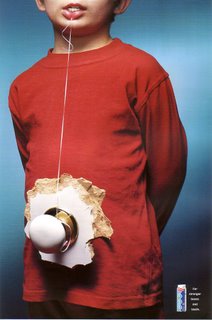


Don't get me wrong. I agree with the a lot (not all) of what Geoffrey has to say. A lot of his articles have some fantastic insights and viewpoints. But when I have a message delivered to me in a way which suggests I'm a stupid moron, so I better sit back in my corner whilst I get told how it's really done, I ain't gonna feel real positive towards the brand am I?

I assume this is not how Geoffrey's agency approaches making a TV ad. Let's tell mum she's a dickhead for not buying Omo. It's about the best clean, stupid! Can't you see that?

So why would you address the marketing community this way? Perhaps it's time to stop writing articles telling marketers 'you don't get it so leave it to the experts', and devoting some time to addressing the situation.

Because, yes, many clients don't understand the role of creativity, as I tried to explain yesterday.

I really like the way Leo Burnett in Toronto talks about the issues they face every day. I think I'd like to work with them.

But for now, I'd like to respond to a couple of comments raised in the above-mentioned article, because there's always two sides to a story, and it got under my skin a bit.

____________________________________________


Why make good, creative ads?

"Because a good ad or two will make your career for years, if not decades. Because you'll be able to say at the bar, or to your mum, "Yeah, that's one of my ads". More importantly, I hope, I care because I think we ought to make ads the public wants to see."

The fundamental difference between agencies and clients is that in agency-land, creative ads are stepping stones to bigger, higher paying jobs. In client-land, being able to show you've grown a brand by x% and delivered record profit results will usually excite potential employers.

So nice ads are one thing. But they're a means to an end. And the end is selling lots of product.

So making a nice or creative ad isn't something us marketers sit there and get all excited about. It's what that ad will do for our business that get's us turned on.

_____________________________________________

I buy into the power of creativity. I've only been told once in my career why creativity is so important, beyond the usual 'cut-through, attention grabbing' stuff. And that was three days ago when I actively searched it out on the net. And the answer I got was this one from Adliterate.....

Why are creative ideas a good idea?


"Creative ideas transfer meaning. Or to be more precise, creative ideas allow the consumer to transfer meaning since the idea itself is quite passive." It's an excellent piece.


Additionally, there's plenty of other stuff around. In the book Waking The Giant by Peter Steidl and Kim Boehm, they talk about how because brands are memories, how do we increase the likelihood of our message being:

a) stored in the memory
b) linked closely to the brand
c) activated frequently

It then goes on to explain why ads which cut through, which emotionally engage, which are new and unexpected, which are of a multi-sensory nature etc, are the ads marketers should be striving to produce.

When's the last time your agency sat down and explained to the marketing team this kind of stuff?

I reckon a lot of marketers would be interested in hearing this. Especially from their ad agencies who live by the credo "Creativity is King'.

____________________________________________

Breaking the Mould

"You have to do new, rather than a re-hash of old ideas. The more unusual it is, the better it will work? I've seen clients (not ours) who want to know who else in their market has had success with this approach? This is the gutless 'we don't want to make a mistake' approach that guarantees disaster".

So the more unusual it is, the better it will work. Just like A Current Affair trots out the same stories night after night, and has been doing so for 20 years, and is one of the most watched shows in the country.

Being unusual does not necessarily mean being creative. The red meat campaign Geoffrey talks about is a creative and good ad, I agree. But it's not unusual.

This is unusual. And buggered if I know what they're trying to say about Westfield Bondi Junction, the best shopping complex in Australia...

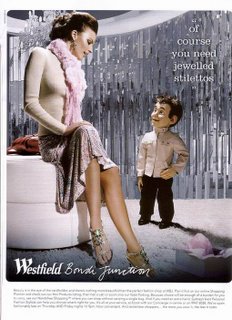

As for the comment about about gutless clients asking who else in the category has had success with unusual ideas, if my Brand Manager didn't ask this question of his agency I would be flabbergasted and a bit pissed.

Isn't it the agency's job to help the client understand what kind of advertising works best in their category? Agencies are the experts. You tell us. Marketers don't spend 100% of their time living and breathing advertising. It's maybe 20%. They're busy being General Managers for their brands and acting as the hub across 30 internal and external functions, and putting out stupid fires. They are jack of all trades.

So as an agency and an expert in advertising, you tell us what's working and what's not and why.

____________________________________________

Are Funny Ads Better?

"Funny always wins over anything else. Do you email your mates serious ads?"

I have never heard any proof that funny ads are more effective than ads that are not funny. I just keep hearing the line from agencies that "funny ads work better".

Deliver me a meaningful insight about the target audience that shows why a funny ad will resonate better with them and work better in the context of solving my brand problem, then I'm all ears.

Just don't keep beating me over the head with stuff like this and then make out I'm an idiot for not buying into it.

____________________________________________________________

What You Should Do if You're a Marketing Manager

"An agency will show a brilliant idea to a brilliant client scribbled on a table napkin. Because that's all an intelligent person will need to see the idea. For a dummy, or people they assume to 'visual cripples', they'll get a storyboard drawn up, illustrated in pretty colours etc"

In other words, trust the agency with their idea, even if you are struggling to understand it or it's merits, before you move ahead.

OK, so a client is about to spend $4 million on a campaign, and another $350k on production, and bucketloads of hours, but they should feel alright about this because it's a brilliant idea even it was drawn on napkin. And you're an idiot of you don't get it straight away.

Wow, if I was a marketer I'd be ditching my current agency so I could work with this kind of rigour and attitude.

People think in different ways. Men and women might be a nice example to begin with. The skill level of marketers when it comes to conceptualising new ideas also differs. Live with it and help them through it. But don't call them cripples. Then they might start conceptualising a new agency.

_____________________________________________

At the shoot

"Yours is not a role that can tell others anything. You're only allowed to watch and, if you're lucky, you can speak with the agency suit"

This must be the 'funny, informative' bit. How dare a client have a point of view. The shoot must be sacred ground.

I've been at shoots where the person has been consuming the product with his hands all over the brand and no-one said anything.

I've been at shoots where a decision about something unexpected came up and I had a different view to the suit about how it should be handled. Surely that's a discussion that needs to be worked through as a team.

I've been at shoots where they've used background products from the competitive company!

I'd heard many similar stories from marketers through the years.

I always try and work with a director who understands he's making an ad (not a film) with my money, and has a vested interest in having a happy client. This is an important part of the selection process.

Of course you stay out of their way as much as you can on shoot days (I've not encountered a situation otherwise). But if something looks out of place then the client has every right to say something. Tactfully and responsibly.


OK, I've got that off my chest now.

For my next entry I think I'll throw a few ideas forward about how to bridge the gap between the different expectations on the agency versus client side.


Tuesday, October 10, 2006

Shagging a Creative Idea

Why is it that it's always the same old brands doing all the innovative, out of the box stuff?

The Nike's, Adidas', and Virgin's of the world.

Is it because they're just more creative marketers?

Is it because their consumers demand it?

Is it because their agencies are better at highlighting the need to do this for their brands?


I don't think their consumers are demanding it at all. Everything is manufacturer driven. If technology advancements stopped right now forever, everyone would probably be pretty happy. Do we really need another fragrance of air freshener (though I still reckon the air freshener brands should be looking at co-branding opportunities)?

So if some brands can force innovative product solutions alongside innovative communication techniques upon the consumer, why can't other brands? I don't think you'd get an argument from the agencies about doing this type of stuff. So whose job is it to educate the marketing teams about the need to develop creative and emotionally binding campaigns for their brands?

The Marketing Director?
The ad agency? The planner?
Your mum?

I think if agencies are the experts in advertising, as they claim every week in Adnews and B&T, then it's their role. The Brand Manager is too busy chasing up R&D trying to get the next 14 biscuit prototypes into the 4th round of quant research.

If I walk up to a girl in a bar and ask her straight away to sleep with me, she'll probably say no. Just like a lot of truly great creative ideas get knocked back straight away. The client's thinking "I'm not familiar with you. Yeah, you look nice but I need to know you better and feel more comfortable around you before I start shagging you"

But what if the girl got to know how good this really creative and different bloke was? Maybe his friends are telling her about what a great catch he is and why, and tell her lots of great stories that break down the level of discomfort. Stories that help her imagine what it would be like to be in the shoes of one of the characters in his stories.

Maybe one day she might hop into bed with him.


Anyway, here's what Adidas did during the World Cup in different locations around Germany. Not only was it great creative, it got lots of PR.

The Adidas version of the Sistine Chapel in Cologne's central railway station...

Full 360 version here


German goalie Oliver Kahn. I actually went under this when I flew out of Munich during my world cup visit (and could see right up his pants)...

Monday, October 09, 2006

Claratyne Clouds

I've not seen many simpler, more powerful ways to visually demonstrate a problem/solution scenario as Claratyne has done in their recent campaign.

For sufferers of hay fever and allergy, this little cloud says it all about how you feel at the time. Fantastic stuff.

Just one improvement though....

There's a 30 second TVC which has about 7 cloudy head scenarios. I reckon you only need to see it twice and you get it. By the end of the ad I'd got it so much I was bored and almost lost interest in who the brand was. This idea is so powerful, 15's would have worked all the way.

The other ideas coming into my head would be to have people walking around the city streets at peak hour with these clouds around their head. Maybe wearing a t-shirt which says "Need Claratyne?"

There's also a nice outdoor waiting to be done. Week one has the billboard totally covered in the cloud, extending outside the boundaries of the signage. In Week 2 the cloud's cleared away and Claratyne the brand is revealed.

Geez, it's easy being a creative hey!


Global warming is playing havoc with the weather and low cloud movement over Sydney

Friday, October 06, 2006

Ad Talk

From cartoonist Hugh McLeod's site Gaping Void. Very true.


I actually found this featured on another very interesting site which highlights the role of consumer engagement in advertising. Engagement on Engagement.

Thursday, October 05, 2006

Dave Grohl is Cool

Dave Grohl is a cool bloke. He's in Sydney this week and having a beer with one of the blokes who got stuck down the Beaconsfield mine six months ago. 'Cos he promised he would.

"I'm not just having one beer with those dudes, we're going for it." he said.

I saw him interviewed on Denton and he's smart, funny and good a pretty good perspective on life. I wish I had 10% of his coolness.

Every band you see is a brand. It's more than just the music, it's the people behind it.

I've never been a big fan of the American rock music scene. Nickelback, Red Hot Chilli Peppers, Foo Fighters etc. It was only when I started realising Dave Grohl was a top bloke that I opened myself up to liking the Foo Fighters, and now it's on high rotation (especially on the iPod during a gym session). He gave me the reason to like the Foo Fighters brand.

Bernard Fanning is the same. I'd love to have a beer with him. Never really got into his band Powderfinger, although I'll probably give them a good listen next time.

That's why a good PR strategy for a brand reaps its rewards. Some of the stuff you do is hard or impossible to measure. But if you can show prospective customers that there's a human face behind your brand, and it's someone you wouldn't mind having a coffee or a beer with because you think you'd like them, that can only be a good thing. Whether it's the Foo Fighters or Vegemite or Panasonic or Westpac.


Dave Grohl with a traveller and one of the miners.


Wednesday, October 04, 2006

Kit Kat's Own Goal

Geez I laughed when I saw this ad for Kit Kat (literally 5 minutes ago). Apparently a big hit on YouTube as well (over 40,000 views). It's the kind of ad that helps the brand stick firmly and positively in my mind.


I saw a Kit Kat ad on TV lately here in Sydney and wondered whether they'd over-thought the strategy to death all the way down the S-bend. For some reason the 'Have a Break. Have a Kit Kat' positioning has been thrown out the window. They spend half the ad talking about how good they've been at innovating with their line extensions, over what's meant to be some really cool, but ultimately really crap animation. I think they're trying to be cool but failing miserably. Nothing is holding this brand together anymore.

With all the Kit Kat line extensions coming out, I would have thought that 'Have a Break' would be the glue. Kit Kat owns it and it still has creative legs. The World Cup ad from the UK above shows you can still be creative and funny with it.

It seems like they've dumped it because it was too hard to force fit the line extensions into it, rather than build a brand around an ownable proposition which has served them well over 20 years and would probably keep going for another 20 more.

Does anyone know why they've moved away from it?

Tuesday, October 03, 2006

Coke's Grand Theft Auto

It's always nice being a marketer of a multinational and the guys overseas actually manage to make some ads that you can run in your own country.

It will be interesting to see if Aussie marketers of Coke take their Grand Theft Auto ad from the States and run it over here. I don't reckon you would need to change a thing.

The ad has had millions of hits on Youtube, GoogleVideo, gaming sites etc and been a big viral success.

An interesting point has been raised by some bloggers about how media agencies should manage something like this. Why put an ad like this on TV (where the media agency makes their money) when the agency can upload it to a few sites for free and let viral take over.

The only risk is that if it doesn't take off, you're left without a campaign. Two things then.....if it's not a hit with the target audience then maybe the ad wasn't that great to begin with.

Secondly, perhaps marketers need to work another 4 months in advance. Launch the viral and you'll know in a month if it's not working. Then you still have 12 weeks to get the ad on TV with enough time to negotiate a good buy.

I still believe the only way a media agency can provide total media-neutral solutions to a campaign is to do away with the upfront negotiations with the TV networks at the start of the year where a committment is put in place to spend x amount. The majority of companies still do this. And that's probably why a lot of campaigns, especially in FMCG, all look the same.

Friday, September 29, 2006

The Art of Branding

There is a huge and passionate arts community in Sydney. And a new initiative by a couple of art collectors has enabled businesses to part with a measly $2,000 for an active involvement in it.

The project is called Signature of Sydney. 450 companies have invested $2,000 each to create the project and put up $150k in prize money.

The task: "Create a new, contemporary icon of Sydney and capture it's real spirit - with it's people, architecture, nature and all the modern businesses that fill this city with life."

Each piece of artwork has to feature the 450 brand names or logo's. Commercially oriented, yes. But with $150,000 up for grabs, there was a strong number of high calibre entries.

Read the article in the Sydney Morning Herald


From a branding sense, for $2k it's a bargain. Everyone in the arts community who's involved in this project will probably have a nice little warm spot in their arty heart for the brands that participated.

Of the 450 brands, guess how many FMCG brands there were?

Two. Huggies and Weet Bix.


__________________________________________________________

This got me thinking about how brands could use this concept. The driver might be where design or colour is a big part of the purchase decision. It might be a way to show you're coooler or more in tune with grass roots than your competitor. Or it could be a good thing to demonstrate premium values, rather than yell the fact to consumers.

Brands like Kleenex Facial Tissues.
Coke or Pepsi
Any half decent wine brand.
Qantas or Virgin Blue.
Gloria Jeans or Starbucks

It could be anything really. Just pick a brand related theme.

Why doesn't a brand start a competition, open to all artists in Australia, where artists integrate the brand into a work of art?

At the end select 12 winners. Every month for a year, a winning (branded) artwork features across a range of media - Avant Cards, Style mags, Metrolites outside museums, art galleries, trendy cafes etc.

Look for ways the artist can get recognised in the arts community. All of the sudden, the brand becomes relevant to everyone involved and potential consumers start to get emotionally engaged.

Starts to paint your brand in pretty special light too.

I reckon you could do it properly, including media, for about $200-250k, and it would be a great way to broaden and strengthen the impact of your brand in the marketplace.


Even this Ken Done piece starts having meaning when you put it in the context of say, the need for sunscreen, or anti-nausea tablets.

Guinness. It's Nothing For You.

Have beer brand? CHECK

Grand Final Weekend? CHECK

Got spare media budget for ad-hoc tactical? CHECK

Get to finally excite agency creatives? CHECK

Have an idea? Umm...

This was on the back page of the Sydney Morning Herald Sports section yesterday.

I'm not sure what it does for Guinness except bring it back to the pack of everyday beer brands. You could plonk any old beer brand behind that lame headline.

Surely there is a quality point of difference in this brand?

The whole "good things take time" thing hasn't been seen for ages in Australia, although I think they're still running with the whole Evolution campaign back in the UK. What's wrong with a brilliantly unique message like that?

Lastly, if you're talking to a Sydney audience, why not at least offer some confidence that the Swans are gonna win? Is Guinness behind us Sydney dudes or not?

Anyway, of course we'll win. Because we have Adam Goodes. Go Swannies!!

Thursday, September 28, 2006

And on the Seventh Day......

Smart FMCG companies are starting to change the way they advertise in a fragmented media environment.

Unlike 5 or 10 years ago, a mass advertising approach against a broad target like mums 25-49 is much more of a hit and miss affair these days.

You just end up with the same old spots in the same old shows. Plus four spots each in New Idea and Woman's Day. Then some metrolites if you can afford it. All very efficient on paper no doubt.

Up & Go Energize is a line extension which is "High Performance, packed with 20 grams of protein for muscle development".

You'd think this would be as niche as it would get. Not so. Our Seventh Day Adventist friends over at Sanitarium have received some nice advice from above and compiled a clever campaign targeting several groups of potential new users.

The TV ad targets the Bloke In The Office. More energy through the day. Helps you pick up chicks too apparently...


Then there's the Teen Dudes. Bring in motorcross star Chad Reed as spokesperson, link it with extreme sports, and create an interactive web site.

OK, the TV ad is as boring as hell, but when you put Motorcross and Seven Day Adventists together, it's going to take some time for them to jump into bed and have multiple orgasms....


Then there's the Gym Junkies. Plastered up at Fitness First centres is a really simple, clear ad.

Just a big pack shot with the words, "Leaving so soon?"

Doesn't matter if you're if you're a girl or a guy...this will help get you through your workout. I've seen plenty of people drinking them as they're walking into the gym.

Fitness First yuppies don't know who Chad Reed is, no-one sees him and no-one cares. But he's probably selling a lot of Up&Go Energize for Sanitarium.

And these little suckers sell at a premium to the regular Up&Go variants. Probably more profitable and incremental to current sales for the Sanitarium crew. They get by with a little help from their friends.

Wednesday, September 27, 2006

Bloody Hell!

It's hard to understand how Tourism Australia got it so wrong with their "Where the Bloody Hell Are You?" campaign in Japan. Surely they would have worked through the cultural and translation issues before launching.

Perhaps they should have employed an approach showcased by big Arnold Schwarzenegger in the ad below for some kind of energy drink called “Vfuyy.

If we had have used someone like Russell Crowe in a similar kind of ad for Brand Australia, they'd be flocking in by the millions....

Tuesday, September 26, 2006

Would You Let Your Brand Pash a Granny?

What would you do to win the 'Ultimate Boys Weekend'?
  • Would you share an ice bath in the middle of the streets with mates?
  • Would you lick your car clean?
  • Would you pash your 80 year old grandmother?

At least Galliano haven't fallen into the trap of trying to be everything to everybody.

With their latest campaign (www.gallianostuntguys.com), they're very clearly targeting the 18-25 year old male who likes push the blokey boundaries from time to time. Welcome to Galliano's new target market.

In essence, it's a nice idea. The Customer Made aspect would be key to a niche brand like Galliano to drive cut through and engagement in a crowded market.

Yet I imagine it would be a difficult brief.....how do you reposition the brand from it's rather pompous high ground so that when it's time for shots with the boys at 10pm, Galliano is the drink of choice? And how much of the premium values of the brand do you try and retain? It looks to be none at all.

I just wonder whether Galliano wants to be the Jackass of spirits? After all, when Johnny Knoxville finishes up work for the day after shoving crocodiles up his arse, I reckon he'll be sitting in the coolest bars in LA surrounded by leggy blondes.

So whilst the likely strategic insight of risk-taking for improved social status looks ok, the campaign has forgotten the emotional payoff.

It leaves you with an aftertaste that's too much like Benny Hill and not enough like Benny Sherman to me.


Monday, September 25, 2006

The Face of Olay II

I know this is the same theme as a previous post, but I still can't believe Olay are using this woman to promote a brand which is meant to make you look younger and more beautiful. Unless they're planning a before and after shot....

Sunday, September 24, 2006

Flashbeer in Double Bay

The Golden Sheaf in Double Bay was getting pretty full yesterday in readiness for the West Cost v Adelaide game to come up on the big screen. Everyone was having a yarn, a drink, a perve...usual pub stuff.

Then Carlton Draught's new Flashbeer ad came on the screen. Everyone stopped, and looked, and just got absorbed in the ad. Heaps of people were laughing and everyone stood there and enjoyed the whole30 or 45 seconds of it or whatever it is.

The great thing about this ad is that there was hardly any sound in the pub. Despite the lack of audio, the ad was great at getting people drawn in. I reckon if you can make an ad work without the sound you've just doubled the chances of it getting into someone's head.

My guess is that next time they're up at the bar deciding between VB, New and Carlton, they'll go with the brand that made them all feel prety good for 30 seconds and made them laugh. And I'm not talking about the ad where they're flinging donkeys into the air which makes no sense whatsoever and has nothing to do with Tooheys New.

Wednesday, September 20, 2006

Infiltration Alert

Just browsing a job ad for a Multimedia Marketing Manager and this paragraph leaped out.......

"Previous experience in e-marketing initiatives, infiltrating online communities with viral communications, deploying guerilla tactics, product seeding and cult/celebrity endorsements would be more than advantageous."

Hold on to your hats if you're a consumer. Your friends in your cosy online community are about to be 'infiltrated'. I imagine this company is not the only one thinking along these lines.

Just be wary the Coke Zero Anti-Movement